Tuesday, October 20, 2009

Kensington USB Car Charger for iPhone and iPod


Car charging accessories are common but rarely sexy; most companies these days seem to be competing to make last year's chargers smaller rather than adding major new features. Kensington's new USB Car Charger for iPhone and iPod ($20) is a prime example, packaging a black USB-to-Dock Connector cable with a very small charging bulb -- it's only a little taller than the third-generation iPod shuffle. Merely for charging rather than audio-out, it's the smallest car charger we can recall seeing, and reasonably priced.

Company: Kensington
Website: www.Kensington.com
Model: USB Car Charger
Price: $20
Compatible: iPod 4G, 5G, classic, mini, nano, touch, iPhone, iPhone 3G,3GS


Security System Products

CCTV (Closed Circuit Television) is today rapidly becoming a key component in modern security systems. Bond offers fully integrated and flexible CCTV surveillance monitored from one central control point to ensure safe and controlled environment to you and guests and to prevent unauthorized access to your premises.

With one person monitoring from central control point a series of events happening simultaneously, the system provides cost effective productivity as well as higher standard of safety. The system enables security to monitor every zone in the building.

Get Net offers cameras that can be placed virtually anywhere out of the public eyes so that the people are not aware of its existence.

Saturday, October 10, 2009

Micro Bluetooth Headset


The tiny Argard M10 Bluetooth headset weighs only 5 grams, but still offers a stand-by time of 100 hours and a constant talk time of three hours.

It comes with a very stylish charging dock station and is a breeze to set up. It’s extremely comfortable to wear, and a joy not to have ear loops or cables tugging at your ears.

Features

* Possibly one of the world’s smallest Bluetooth headsets.
* The headset uses Bluetooth Version 1.2, Class 2.
* An intuitive touch button control system.
* Push the ‘Talk Button’ on the end of the headset to answer and end your calls.
* Volume Buttons are located on the headset so you can control the volume without ever having to access your phone.
* The headset comes with spare earpieces so will fit the larger and smaller lobed person.
* A stylishly designed black charging cradle.
* Requires a mains adaptor (included) for charging.
* A full charge is equal to 3 hours talk time or 100 hours standby.
* Size: 2.3 x 2.2 x 3.15cm.

The Micro Bluetooth Headset is available at IWOOT for £99.99 (about $197).

USB Flash Drive Light Bulb


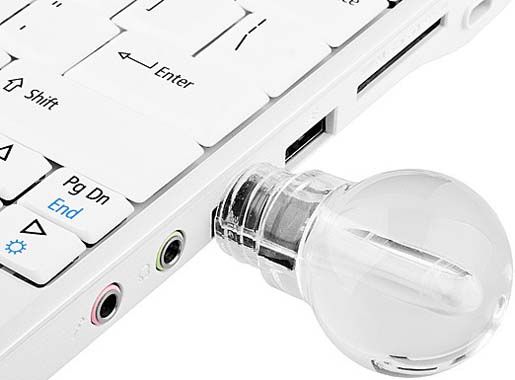
You may have come across more pen drive models including USB light, but this is a complete different type of USB Light. A gadget lets you carry around your data easily. Moreover, it seems like a light bulb for your real experience. You can have this device in three different capacities such as 2GB, 4GB and 8GB. The price of the devices are $19, $22 and $32 respectively.


Some Important Features of the Device:
•Bulb shape design
•USB 2.0
•Portable and easy operation
•Plug and Play
•Support Window XP/Vista, Linux 2.4, MAC OSX or latest version
•Dimension: 65 x 28 x 28mm (approx.)
•Weight: 26g

Printer With Digital Camera


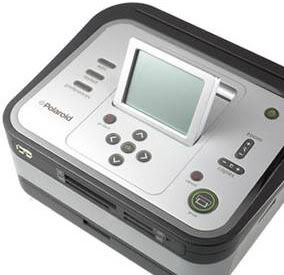
Essential has become an essential thing to Polaroid in making of digital products for deliberated inventiveness.This company hopes that its creativeness would take it to make better product than creating an instant photography.In such a way they have introduced their maiden Digital Printer.

This is an easy accessible and compact printer.Digital camera and storage media are inbuilt in this printer.The whole architecture and design language of the printer are created by the Essential group.This maiden digital product

Tarius UV Rays detector


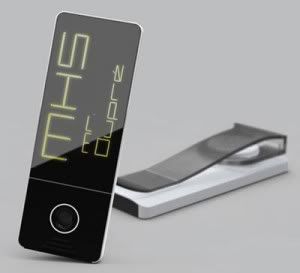
Tarius UV Rays detector is especially designed for people who works in the surroundings of UV lights emission.

The device features a crispy LED display to show the readings and can be easily controlled with one touch button located in the lower part of it. There is a clump behind the device that helps the user to attach it with their belts, jackets or other convenient places.

It is an innovative and functional concept gadget that can be attached onto a user’s jacket or hose to detect UV rays both natural and artificial.

Fitbit is the coolest personal fitness checker


How cool is something that can attach to your shirt and records your activity, movement and every damn bit if fat you’ve been accumulating under your skin. Cheers to the Fitbit, you can know how well you sleep, how good you exercise, how many calories you burn and how much you travel in a day. Thanks to the cool 3D motion sensor, all of these are recorded pretty easily. The recorded data is then transmitted to a base station located nearby. Isn’t that totally awesome? Other features include an OLED display for monitoring purposes and a cool battery life of 10 days.

TOSHIBA CAMILEO S10

TOSHIBA HAS ANNOUNCED THAT IT IS ENTERING THE POCKET CAMCORDER MARKET WITH THE LAUNCH OF FOUR NEW POCKET CAMCORDERS RANGING FROM 99 POUNDS TO 179 POUNDS.

samsung i900 omnia

After long time samsung launches its most awaited product in india i900 better known as OMNIA...


Simply talking it contains every thing which you want in your phone.Last week the beauty queen,LARA DUTTA launches it.In India it is available in two variants 24 GB & 32 GB which will cost you 37,990 &39,000 resp.
In my opinion it better buy than i-phone.......

Amazing technology from Japan . . . . but can you guess what it is ?

Look closely and guess what they could be...

Are they pens with cameras?


Any wild guesses? No clue yet?
congratulations! You've just looked into the future... yep that's right! You've just seen something that will replace your PC in the near future. Here is how it works:

This "pen sort of instrument" produces both the monitor as well as the keyboard on any flat surfaces from where you can carry out functions you would normally do on your desktop computer.

Miniature TRACKER position sensors fit into existing spaces in miniature cameras and other systems, reducing power use and improving precision of focu


  • Trends… - What worked pre-internet for managing information will not work today. Little surprise then that trend watching / recognition is quickly becoming a field of value for educators, business leaders, and governments.
  • History and Evolution of Social Media - We are still early on the social media hype curve. Letting people connect effortlessly produces all kinds of interesting results. But the implications of easy connectivity are not fully understood.
  • The Great Keynote Meltdown - It seems that a poor keynote presentation caused the audience to go into mild mob mode through the twitter back channel.
  • Personal Learning Environments Conference -
    The Personal Learning Environments and Networks Conference starts next week (Oct 13-16). The event is free to attend. The event has been organized by National Research Council of Canada PLE Project and the Learning Technologies Centre at University of Manitoba.
  • Obesity, Politics, STDs Flow In Social Networks - I am interested in how networks influence learning. To date, this has received too little attention from researchers. Yes, I know, disease research generates more funds for universities
  • Real Time Web and Google - Clive Thompson's argument that the real time web is leaving Google behind makes a few interesting points… but it is essentially wrong.
  • Saudi Arabia: KAUST - Education is rapidly globalizing. Local views need to give way to international perspectives. For example, consider the new $12 billion Saudi Arabian KAUST
  • Local Politicians Use Social Media To Connect With Voters - Something as simple as an online forum or blog - or even online consultation - is not unrealistic. Decision made in isolation and then dropped on others is no way to run an organization or a community.
  • Social Network Statistics - We rely on government to provide some level of protection (in Canada we have fairly rigid rules for the type of individual data that can be shared). Even then, sites like Facebook can gain a fairly accurate "picture" of who individuals are simply by mining network associations.
  • Finding Data - Let's say you have this idea for a visualization or application, or you are just curious about some trend. You can not find the data, and without the data, you can not even start


Miniature TRACKER position sensors fit into existing spaces in miniature cameras and other systems, reducing power use and improving precision of focus and zoom. Learn more.
NSD-1202 dual piezo motor driver in a 4x4 mm QFN package. Each ASIC drives two SQL-1.8 SQUIGGLE motors, controlled via I2C interface. Learn more.

Micro Motors


NSD-1202 dual piezo motor driver in a 4x4 mm QFN package. Each ASIC drives two SQL-1.8 SQUIGGLE motors, controlled via I2C interface. Learn more.

Tracker


Developer’s kit and reference design: Battery operated, ready-to-use kit includes a TRACKER NSE-5310 miniature position sensor (TSSOP package), along with a SQUIGGLE micro motor to provide precise motion, and New Scale's Pathway Software. Kit serves as mechanical and electrical reference design; all components can be easily removed for integration into your prototype. Learn more

Electronics Recycling


Rapid technological change encourages consumers to abandon their old consumer electronics products and purchase the newest releases. This leaves a slew of discarded products and a lot of waste. An estimated two million tons of electronic waste enter U.S. landfills each year, with only 10 percent being recycled. The National Safety Council estimates that nearly 250 million computers will become obsolete in the next five years and mobile phones will be discarded at a rate of 130 million per year. [1][2]

Improper disposal of electronics products that contain toxic materials can cause harmful environmental impacts. Computer monitors and older television picture tubes can contain up to four pounds of lead. Other toxic materials found in electronics products include chromium, cadmium, mercury, beryllium, nickel, zinc, and brominated flame retardants. Reuse or recycling of electronics can lead to safe management of these hazardous materials when a product reaches the end of its useful life.

Donating electronic items for reuse provides positive environmental and societal benefits. Reuse and refurbishing electronics provides environmental benefits by preventing waste, extending useful life and keeping products from entering the waste stream until a later time. Society benefits from donation because schools, nonprofit organizations, and lower-income families are able to reap the benefits of computers and other electronics that they otherwise could not afford.

Waste reduction can also be achieved by purchasing greener products. The Environmental Protection Agency (EPA) provides a list of attributes that describe environmentally preferable electronics products:

• Contain fewer toxic constituents.
• Use recycled materials in the new product.
• Are energy efficient (e.g., showing the Energy Star label).
• Are designed for easy upgrading or disassembly.
• Use minimal packaging.
• Offer leasing or takeback options.
• Have been recognized by independent certification groups (such as TCO or Blue Angel) as environmentally preferable. [3]

If reuse is not an option and a product is no longer functional, recycling can help to alleviate negative environmental impacts of electronics waste. Recycling electronics can help to reduce energy use and pollution produced from the manufacture of new products. Recycling also aids in the preservation of valuable and limited virgin resources.

More than 100 million pounds of materials from electronics are collected annually by recyclers. County recycling drop-off centers, electronics recycling companies, some electronics retailers and electronics manufacturers accept electronics for recycling. The Electronic Industries Alliance provides a resource to find local and national electronics reuse and recycling programs. In addition, some original equipment manufacturers (OEM), including Apple Computer Corp., Dell Inc. and Hewlett-Packard Co. have initiated computer recycling programs.

The process of recycling e-waste involves dismantling products into metals, plastics and circuit boards for component recovery. Material is fed into a hopper then travels up a conveyor and is dropped into a mechanical separator, which is followed by a number of screening and granulating machines. The entire recycling machinery is enclosed and employs a dust collection system. [4]

Standards related to electronics recycling include regulatory requirements for generators of cathode ray tubes (CRTs) and circuit boards. Cathode ray tubes, the glass video display component found in television and computer monitors, are considered hazardous when discarded because of the lead found in CRTs. When electronics containing CRTs are left in landfills, lead can leak out into the ecosystem. Various state regulations deal with the management of CRT. Massachusetts and Florida have implemented regulatory streamlining, electronics recycling infrastructure development, time-limited state funding to encourage recycling. California regulates CRTs hazardous material and bans their disposal in landfills. The EPA-proposed federal rule concerning cathode ray tubes streamlines management requirements for recycling used CRTs and glass removed from CRTs in order to encourage reuse and recycling.

Used computer monitors and televisions disposed of by households or resold/donated are not considered hazardous waste and are not regulated under federal requirements. Businesses and other entities that generate less than 100 kilograms (roughly 220 pounds) per month of hazardous waste, including CRTs, receive a small quantities exemption and are not regulated by federal requirements. Facilities that generate large quantities of hazardous waste (over 100 kilograms per month) are subject to federal regulations. CRTs must be manifested and sent as hazardous waste to permitted landfills. CRTs sent for recycling are also regulated by federal law.

The EPA has also proposed a final rule which adds mercury-containing equipment to the federal list of universal waste to encourage better management of these materials and compliance with hazardous waste requirements. The Universal Waste Rule exempts certain wastes which contain hazardous materials, such as batteries, pesticides, mercury-containing equipment, such as thermostats and lamps containing fluorescent bulbs, from having to meet all requirements of the federal Resource Conservation and Recovery Act. The intent of the rule is to lower administrative and regulatory burdens to encourage recycling and proper disposal of hazardous waste materials.

There are various state and international ideas regarding who is responsible for the cost of recycling electronics. In Washington, a state law was recently passed which requires manufacturers, as opposed to consumers or government, to pay for the collection, transportation, and recycling of computers, monitors, and TVs from consumers, small businesses, schools, small government entities, and charities. [5] The European Union has enacted legislation, the Waste Electrical and Electronic Equipment Directive, placing the burden of recovery and recycling costs on manufacturers. California has enacted Advanced Recovery Fee legislation that holds consumers responsible for recycling costs by adding a charge at time of purchase of a new television or computer monitor to fund a statewide recycling program.

EPEAT, a project of the Green Electronics Council, is a tool designed to help large volume institutional purchasers evaluate, compare and choose monitors, desktop and notebook computers based on environmental attributes. EPEAT also provides manufacturers with performance criteria for environmentally responsible design of products. EPEAT is the implementation of IEEE Standard 1680, which “defines environmental performance standards for personal computer products, including desktop computers, notebook computers, and computer monitors that are marketed to institutions, and includes key concepts and implementation procedures relating to reduction or elimination of environmentally sensitive materials, materials selection, design for end of life, life cycle extension, energy conservation, end of life management, corporate performance and packaging.” [6]

The 2006 IEEE International Symposium on Electronics and the Environment held in May of 2006 provided a forum for professionals involved from academia, industry and public policy areas to discuss electronics recycling and other topics related to electronics and the environment. The conference focused on life cycle assessment, nanotechnology, ethical issues, energy generation and supply, policy and business, design for energy efficiency, economic models, green manufacturing, material recovery, design for the environment, small tech manufacturing, industrial ecology, final disposal, international outlook, and material challenges.

References

[1] “EU Ban Opens E-Waste Market.” Red Herring, July 2, 2006.
[2] "e-Cycling." Environmental Protection Agency. http://www.epa.gov/ecycling/index.htm
[3] "How to reduce electronics waste." Environmental Protection Agency. http://www.epa.gov/ecycling/basic.htm
[4 "Electronic waste." Wikipedia. http://en.wikipedia.org/wiki/E-waste
[5] “Who Pays for E-Waste?” IEEE Spectrum, July 2006.
[6] IEEE Standard for Environmental Assessment of Personal Computer Products, Including Laptop, Personal Computers, Desktop Personal Computers, and Personal Computer Monitors. IEEE Std 1680™-2006.

Cheap naked chips snap a perfect picture


amera - be made cheaper and less complex? Easy: take the lid off a memory chip and use that instead.

As simple as it sounds, that pretty much sums up a device being developed by a team led by Edoardo Charbon, of the Technical University of Delft, in the Netherlands. In a paper presented at an imaging conference in Kyoto, Japan, this week, the team say that their so-called "gigavision" sensor will pave the way for cellphones and other inexpensive gadgets that take richer, more pleasing pictures than today's devices. Crucially, Charbon says the device performs better in both very bright light and dim light - conditions which regular digital cameras struggle to cope with.

While Charbon's idea is new and has a patent pending, the principle behind it is not. It has long been known that memory chips are extremely sensitive to light: remove their black plastic packages to let in light, and the onrush of photons energises electrons, creating a current in each memory cell that overwhelms the tiny stored charge that might have represented digital information. "Light simply destroys the information," says Martin Vetterli, a member of the EPFL team.

A similar effect occurs aboard spacecraft: when energetic cosmic rays hit a cell in an unprotected memory chip they can "flip" the state of the cell, corrupting the data stored in the chip.

What Charbon and his team have found is that when they carefully focus light arriving on an exposed memory chip, the charge stored in every cell corresponds to whether that cell is in a light or dark area. The chip is in effect storing a digital image.

All very clever, you might say, but why would anyone want to do that? The answer is that the two types of sensor chips used in today's digital cameras store the brightness of each pixel as an analogue signal. To translate this into a form that can be stored digitally, they need complex, bulky, noise-inducing circuitry.

The charge-coupled device (CCD) sensors used on early cameras and camcorders, and the cheaper and more modern complementary metal oxide semiconductor (CMOS) type both operate on a similar principle. On each, the area that forms an individual pixel can be thought of as a small charge-containing "bucket". The size of the charge contained in one of these buckets depends only on the amount of light falling on it.

In a CCD, the contents of each bucket of charge are "poured" into the bucket next door, and then the next until the signal reaches the edge of the chip. There, an analogue-to-digital converter (ADC) typically assigns it an 8-bit greyscale value, ranging from 0 to 255. In a CMOS sensor, the charge is converted to a voltage local to each pixel before being shunted off to an ADC at the edge of the chip - where it too is assigned a greyscale value between 0 and 255 (see diagram).

A memory chip needs none of this conversion circuitry, as it creates digital data directly. As a result, says Vetterli, the memory cell will always be 100 times smaller than CMOS sensor cells; it is bound to be that way because of the sheer number of signal-conditioning transistors the CMOS sensor needs around each pixel. "Our technology will always be two orders of magnitude smaller," he says.

So for every pixel on one of today's sensors, the memory-based sensor could have 100 pixels. A chip the size of a 10-megapixel camera sensor will have 100 times as many sensing cells if implemented in memory technology - hence the choice of the gigavision name.

But don't expect a gigapixel camera any time soon. Unlike the pixels in a conventional sensor, which record a greyscale, the cells in Charbon's memory-chip sensor are simple on-off devices: they can only store a digital 0 or 1, for which read either light or dark. To build a sensor that can record shades of grey, EPFL engineer Feng Yang, who presented the Kyoto paper, is developing a software algorithm that looks across an array of 100 pixels to estimate their overall greyscale value.

It's a technique called spatial oversampling - and while it's early days, he's getting somewhere. "It's turning out to be a lot more accurate than the greyscale values you get from regular CMOS sensors," says Vetterli. "Analogue to digital conversion gives only poor estimates of the actual analogue light value."

Toshiba's Satellite T100 Series laptops charge while they sleep


Toshiba's new middleweight T100 Series laptops will hit shelves on October 22, coinciding with the release of Windows 7. Both the 11.6 inch and 13.3-inch models come in at under 4 pounds and feature a LED backlit widescreen displays, built-in webcam with face recognition, HDMI port, up to 9 hours of battery life and the company's very useful "Sleep-and-Charge" technology, which lets you power up portable devices when the laptop is turned off.

The 13.3-inch Satellite T135 and the smaller T115 both run on Windows® 7 Home Premium operating system, use DDR3 RAM and feature 802.11b/g/n wireless. The hard drives - which start at 250GB (5400 RPM) - are protected by Impact Sensor technology which detects sudden movement and “parks” the heads of the HDD to minimize any damage before the laptop hits the floor.

Both models also feature full-sized keyboards, multi-touch control pads and come in red and black finishes (a white finish os also available for the T135). The pricing is also worth noting - the T135 starts at US$600 and the T115 starts at $450.

Here's a run down of the key specs:

    Toshiba Satellite T135:
  • 13.3-inch diagonal widescreen HD TruBrite™ LED Backlit display
  • Windows 7 Home Premium operating system
  • Intel® Pentium® SU4100 processor or Intel® Pentium® SU2700 processor
  • DDR3 RAM
  • Starting at 250GB (5400 RPM) HDD
  • 802.11b/g/n wireless and 10/100 Ethernet
  • Bluetooth V2.1 + EDR (available on select models)
  • Toshiba Hard Drive Impact Sensor
  • Touch Pad with Multi-touch Control
  • Weight - 3.88 lbs.
  • Long-life 6-cell battery delivering up to 9 hours of battery life
  • One eSATA/USB combo port with USB Sleep-and-Charge and two USB 2.0 ports
  • HDMI port
  • Built-in Webcam with Toshiba Face Recognition, stereo speakers and microphone
  • Toshiba PC Health Monitor
  • 5-in-1 Memory Card Reader Slot

The Toshiba Satellite T115 carries the same specifications except it's lighter at 3.49 lbs., has an 11.6-inch diagonal display and a choice of Intel® Pentium® SU4100 processor or Intel® Celeron® 743 processor.

First Test Shots posted for Sony A230!


!
We've just posted a full set of test shots taken with the Sony A230 digital SLR camera. The Alpha A230 is Sony's new entry-level SLR offering an APS-C sized 10.2 megapixel image sensor with in-body image stabilization. The sensor resides behind a Sony Alpha (Minolta A) lens mount, and the Sony A230 is capable of shooting at 2.5 frames per second. Other features include ISO sensitivity from 100 to 3,200, shutter speeds from 30s to 1/4000s plus bulb, improved Dynamic Range Optimization, a nine-point autofocus system, and a 2.7-inch LCD. See our Sony A230 Preview for more details, and the Sony A230 samples page for all the test shots, including links to select RAW files.


©2009 New Technologies | by TNB